

Central sensitisation - the explanation that changes everything
Your pain is real. Your body is not broken. Your nervous system is doing exactly what it learned to do. Here's why that's actually good news

If you live with chronic pain, there is a very good chance that at some point someone has implied - with their words or their silence or their inability to find anything wrong, that your pain might be in your head.
I want to address this directly, clearly, and once and for all. Your pain is not in your head. It is produced by your brain - which is an entirely different thing. And understanding the distinction between those two statements might be the most important thing you read about your chronic pain.
First: what pain actually is
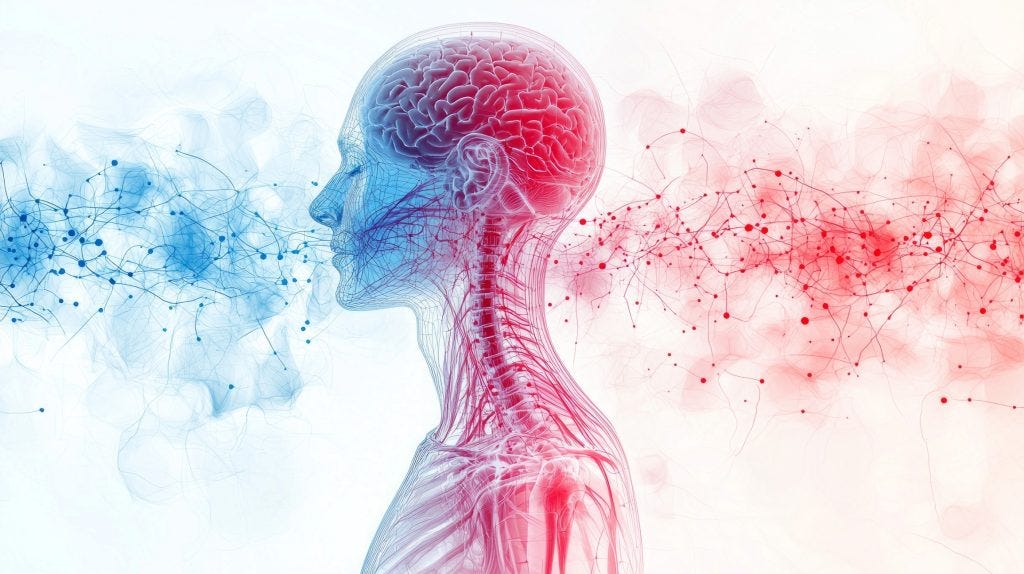
Pain is not a thing that happens in your tissues. Pain is an experience produced by your brain, based on information your nervous system sends it. The purpose of pain is protection- it is your brain’s alarm system, designed to alert you to potential danger so you can take action to keep yourself safe.
In acute pain - a broken bone, a burn, a surgical wound- this system works exactly as intended. The tissue is damaged, the danger signals travel to the brain, the brain produces pain to stop you using the injured part, and as the tissue heals, the pain resolves.
Chronic pain is different. In chronic pain, this alarm system has become dysregulated. It has been running for so long, at such intensity, that it has changed. The nervous system has adapted - and not in a helpful direction.
What central sensitisation means
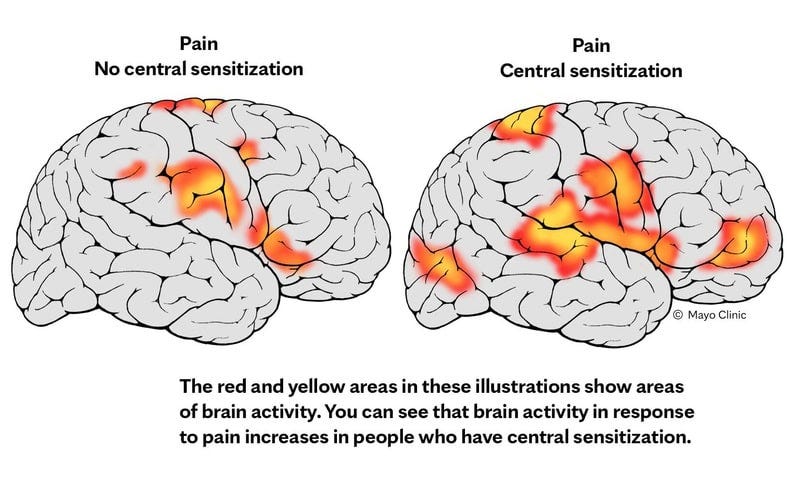
Central sensitisation is the name for the process by which the nervous system becomes chronically hypersensitive. The pain-signalling pathways - the neurons that carry danger signals from the body to the brain — become more efficient. More responsive. Lower threshold. They fire more readily, carry signals more powerfully, andproduce pain more easily than they did before. The result is a nervous system that has essentially learned to be in pain. Not because the original tissue damage is still there -often it has healed. But because the system that processes pain signals has been recalibrated toward sensitivity. It is now better at producing pain than it was before.
Think of it this way: a smoke alarm that goes off every time you make toast is not broken. It is oversensitive. The alarm is real - the sound is real, the signal is real — but it is no longer accurately reflecting the level of danger present. Central sensitisation is your nervous system’s alarm doing the same thing.
Why this matters and why it is good news
Understanding central sensitisation does not mean your pain is less real. It means we understand why it is happening. And crucially, it means we know it can change.
The nervous system is plastic. Neuroplasticity is the brain’s capacity to learn and adapt, works in both directions. A nervous system that has learned to be hypersensitive can, with the right interventions, learn something different. The pain gates can be gently encouraged to close. The alarm system can be recalibrated.
This is not quick. It is not a cure. It requires consistency and patience and a toolkit of approaches. But it is real. And it is the foundation of everything I do with clients- and everything I do for myself.
Science Meets Soul angle on this
Here is something that took me time to fully appreciate, even as a clinician: the nervous system does not distinguish neatly between physical and emotional inputs. Fear opens pain gates. Low mood opens pain gates. Chronic stress keeps the alarm system activated even when the original danger has gone. And the reverse is also true. Meaningful activity closes pain gates. Safety, a felt safety, not just intellectual safety calms the alarm. Practices that genuinely activate the parasympathetic nervous system shift the sensitised system toward regulation. Cold water immersion. Essential oils that act on GABA and limbic pathways. Time in nature that measurably reduces cortisol. Values-led living that creates a sense of meaning and purpose. Breathwork that activates the vagus nerve directly. These are not soft add-ons to the real work. They are mechanisms. They work on central sensitisation through pathways that compliment Therapies such as CBT and Physiotherapy.
The Science meets soul approach- and in the treatment of chronic pain, the soul interventions often have the most direct access to the nervous system of all.
If you are reading this and you have been told your pain is in your head - I want you to know: it is in your nervous system. It is real. It has a mechanism. And you are not making it up, exaggerating it, or failing to recover from it. You are living with a system that learned something it no longer needs to know. And that system can learn something new.
With love,
Sheena xx
P S Y C H O T H E R A P I S T · T H E P A I N T H E R A P I S T · S C I E N C E M E E T S S O U L

Thank you for posting. I can really relate to this. Recently wrote about my chronic pain story and what worked. And it wasn’t physio or injections! https://substack.com/@monicababich/note/p-197544493?utm_source=notes-share-action&r=53fuw (in case you’re interested)